Conversation Flow
Evolving the chat interface to move beyond the limitations of linear scrolling
Team Members


Holly Zhu

Holly Zhu
Cole Biehle

Hanara Nam

Celine Tseng

Dave Song
The Problem
Context Loss in Long-Running AI Work
With most generative AI platforms built around a strict, linear chat structure, users often find themselves quickly lost in conversations and chats. As prompts accumulate and conversations grow longer and more complex, chats become difficult to navigate, forcing users to scroll endlessly to locate a particular output from before.
This friction is especially pronounced for frequent users who return to chats days or weeks later to reuse crafts, refine ideas, or iterate on code. While the information still exists, it is buried within a continuous stream that relies heavily on users’ memory and patience to navigate.
Even when users do find the output they are looking for, iterating becomes another challenge. Follow-up prompts often inject new, unrelated outputs in between, pushing the original output further away. This makes it difficult to refine or build on a single result without noise, breaking focus and increasing cognitive load.
Together, these issues make it difficult for users to effectively navigate long conversations, revisit meaningful outputs, and iterate on ideas without losing focus. These frustrations led us to a key question:
How might we help frequent users easily navigate, revisit, and iterate on previous inputs and outputs within a long-running, linear chat?
Academic & Secondary Research
Findings from both an exploration of current solutions and user research suggest that while users benefit from non-linear ways of thinking and iterating with generative AI, they prefer solutions that build on familiar chat paradigms rather than replacing them.
Prior work such as Midjourney demonstrates how lightweight UI affordances can reduce friction in prompt iteration, while platforms like LAIERS highlight the potential of tree-like, non-linear conversation structures for exploration and comparison. Guided by these insights, we explored three design directions: enhanced timeline-based navigation within long chats, bookmarking meaningful outputs for later reuse, and a tree-based chat flow.
User research revealed that although tree-like visualizations were conceptually interesting, they introduced higher cognitive load and learning effort, and raised feasibility concerns beyond our problem scope. In contrast, navigation and bookmarking features are consistently tested as intuitive, quick to understand, and aligned with users’ existing mental models, supporting non-linear behavior without disrupting the overall chat structure.
From Framing to Exploration
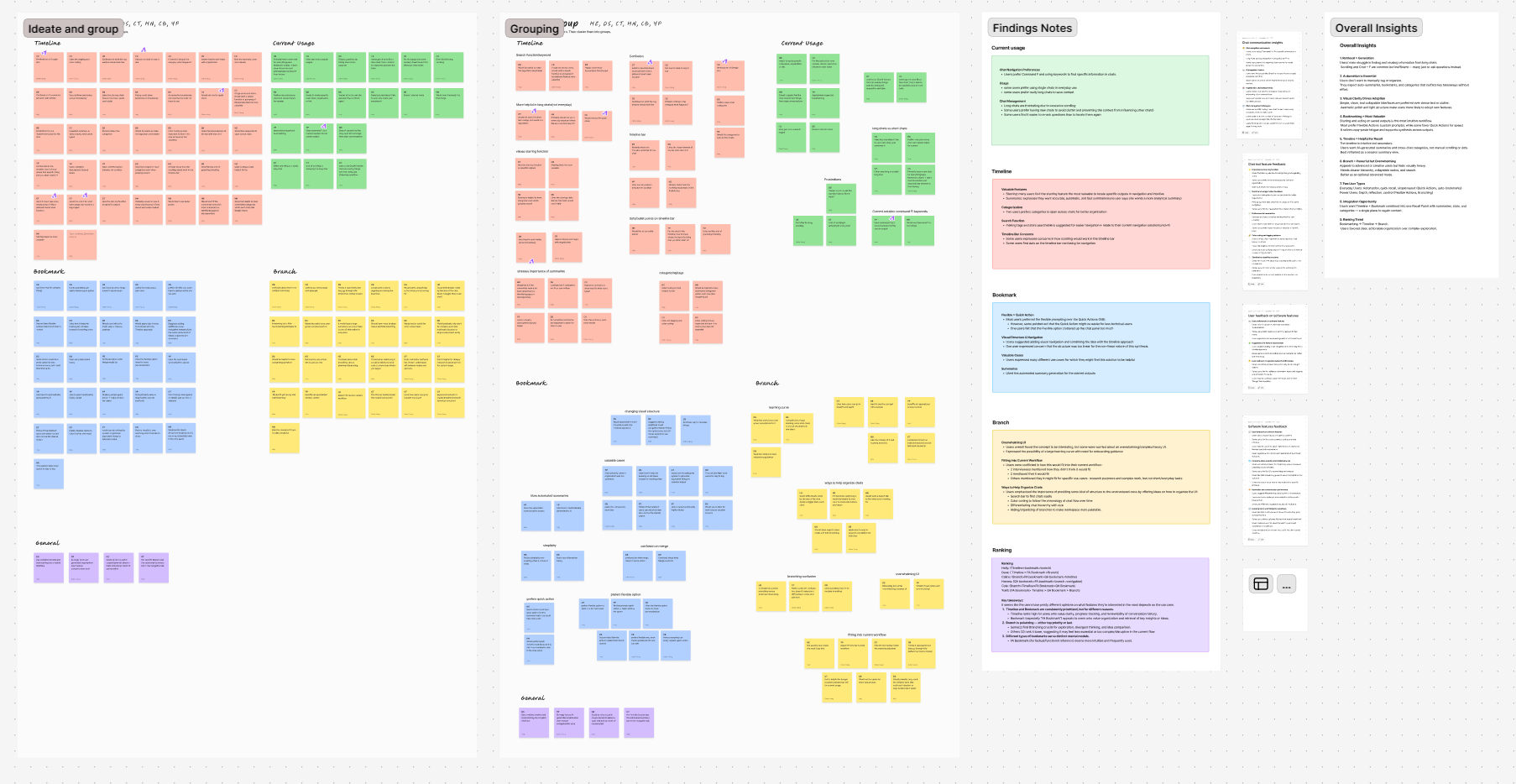
Bringing together insights from research helped us land on a clear design question. From there, we moved straight into visual thinking. We used structured sketching to explore multiple directions before narrowing, rather than locking into one idea too early.
Design Exploration
We explored two parallel concepts based on different assumptions about how people begin work.
Some users start with intent and want structure immediately. Others start by exploring ideas before committing to a direction. Instead of forcing a single solution, we designed two distinct starting experiences.
Insight 1
The Limits of Always-on Structure
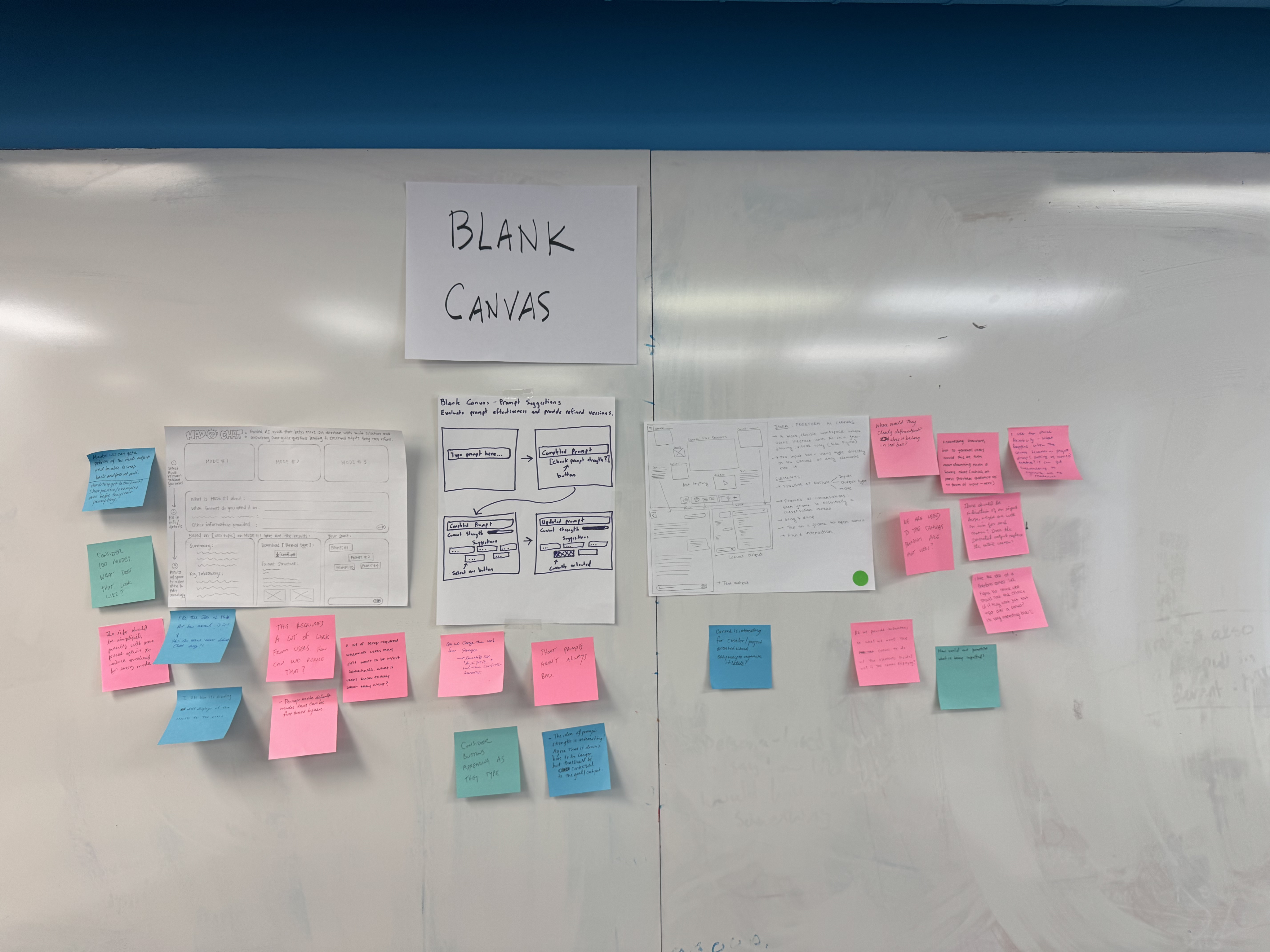
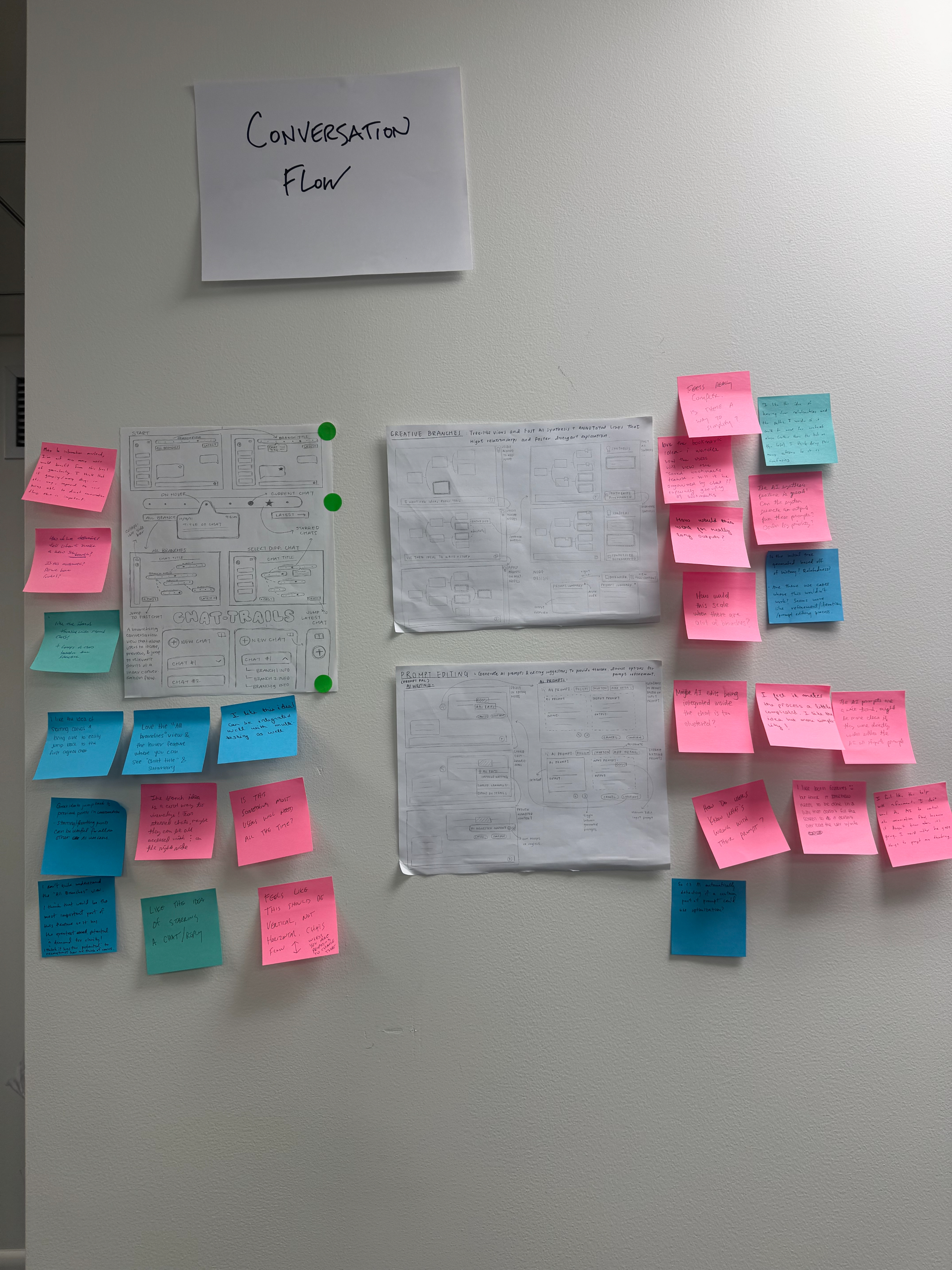
Our first round of exploration pushed on how far AI conversations could be reshaped to support non-linear thinking. Concepts like Creative Branches, Prompt Editing, and Chat Trails experimented with making structure explicit. They explored branching conversations, externalizing prompt iteration, and visualizing chat history as something users could navigate and manipulate. While these ideas opened up new expressive possibilities, users were often unsure where to look, what to focus on, or how much they were expected to manage. Persistent visual structure risked pulling attention away from the conversation itself. This helped surface an early insight: adding structure alone does not guarantee clarity. Without careful restraint, even well-intentioned tools can make long conversations feel heavier rather than more navigable.
Insight 2
Letting the Conversation Lead
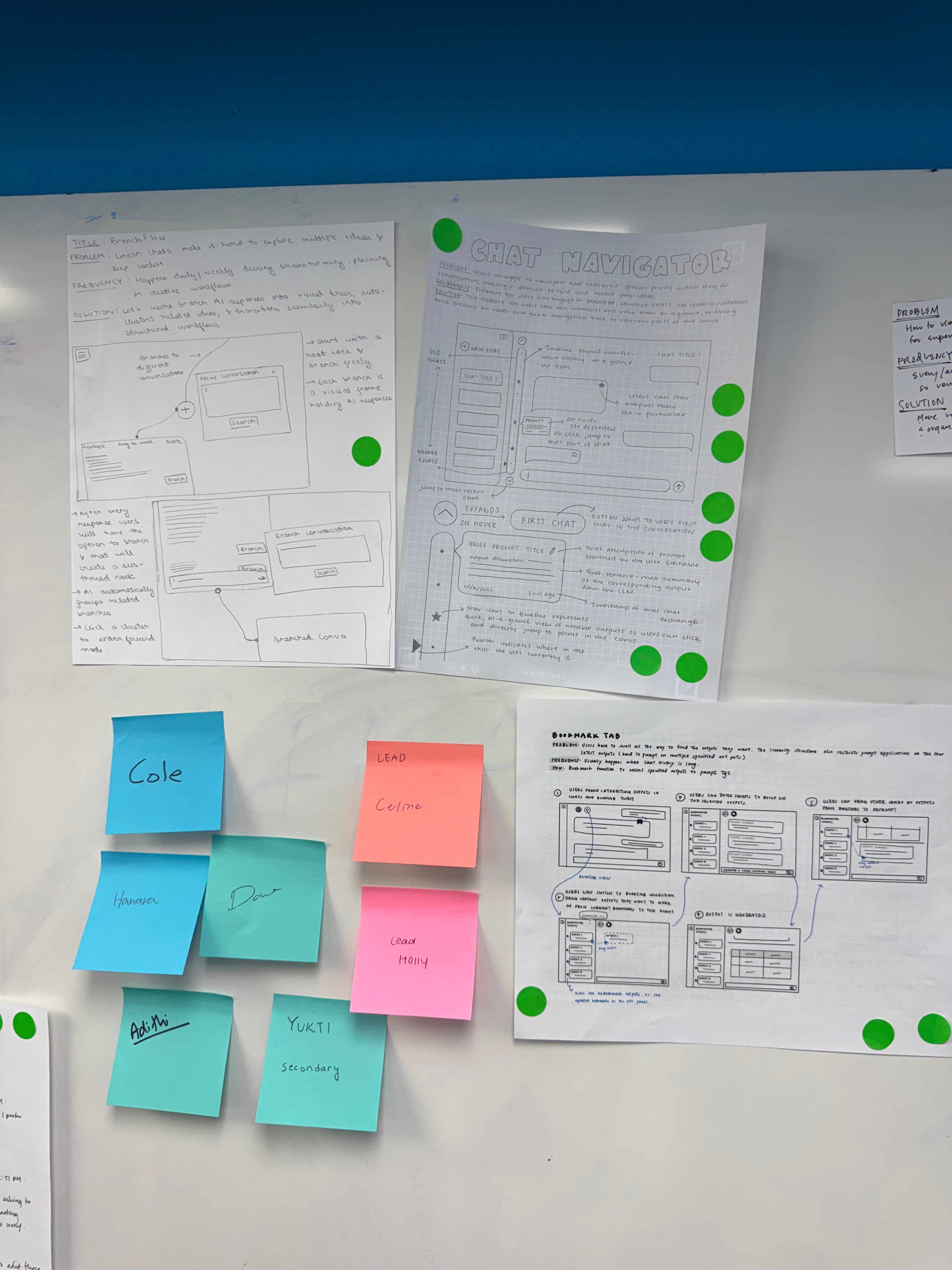
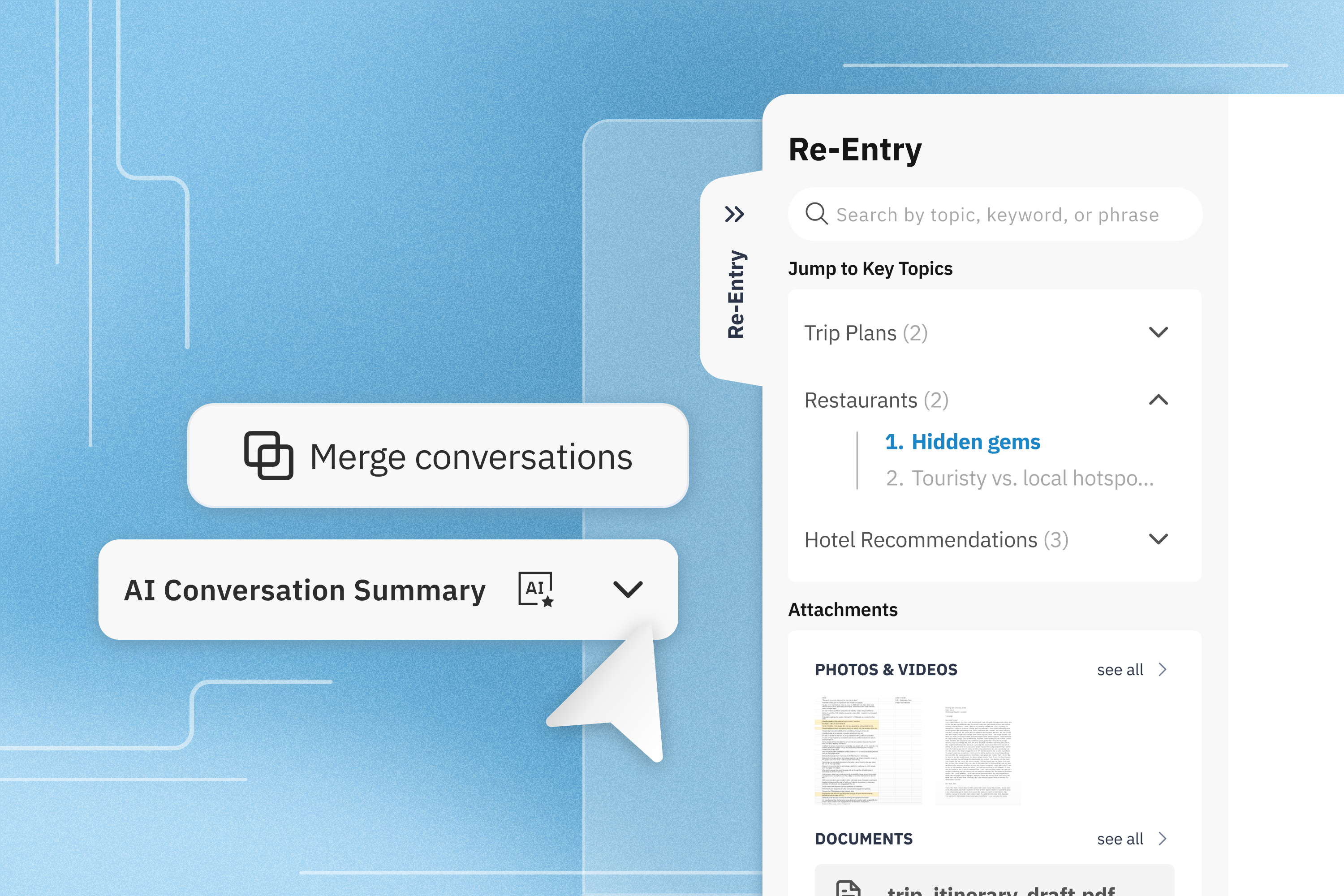
Building on those early learnings, our second iteration narrowed toward interventions that worked with the linear chat instead of abstracting away from it. Concepts like Chat Navigator, Bookmark Tab, and BranchFlow focused on helping users refine without asking them to manage an entirely new structure. Feedback showed that users valued having clear lightweight anchors such as saved outputs, summaries, and visible milestones. At the same time, this round surfaced another important constraint: users wanted control over when structure appeared and preferred tools that stayed out of the way until needed. This reinforced a second key insight: effective navigation in AI chats should feel optional and on-demand, supporting re-entry and iteration without competing for attention during active thinking.
User Testing Insights
Using feedback to simplify the experience and focus on what mattered most.
Takeaways from Testing
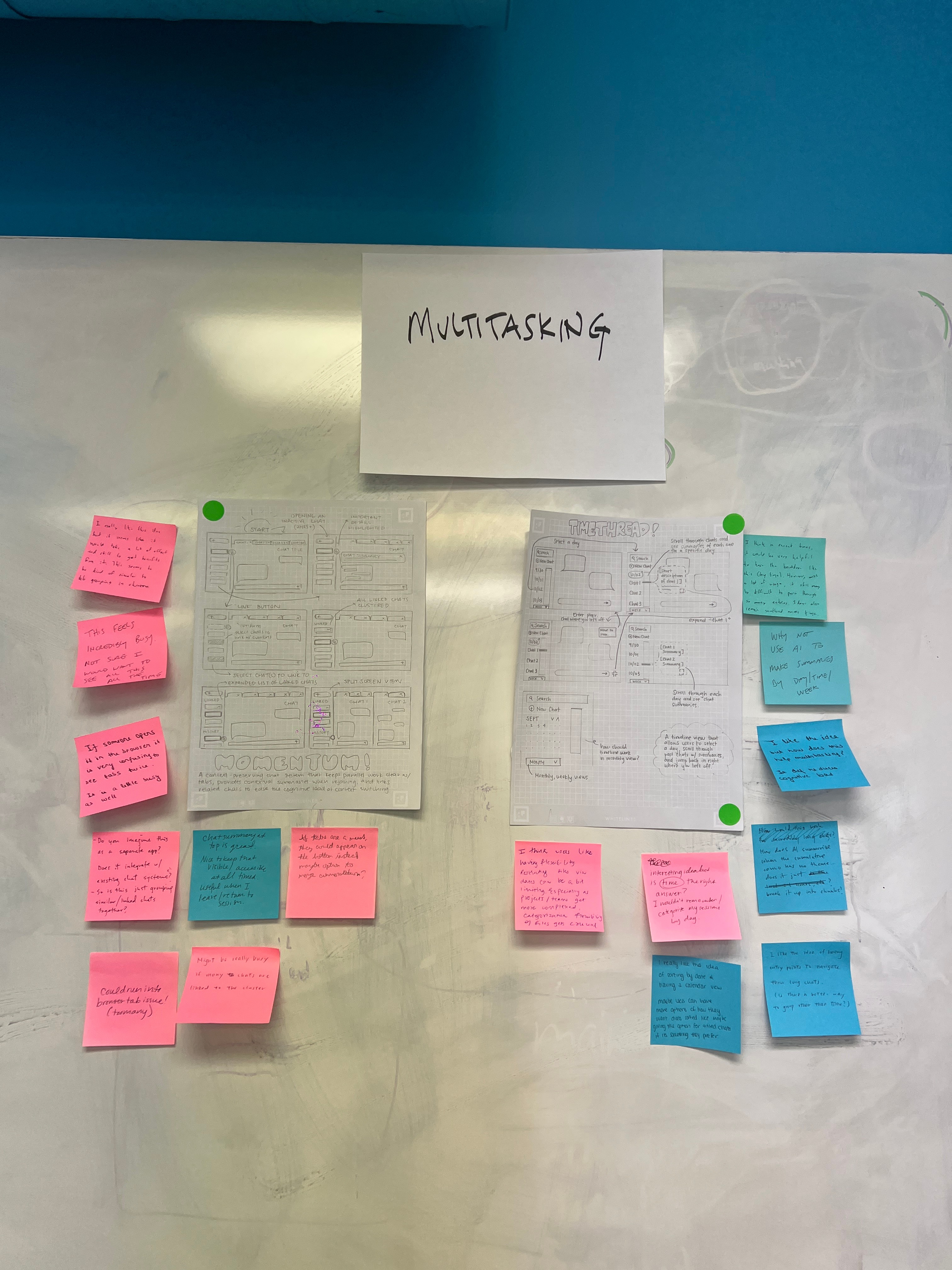
User testing clarified that the core problem was not a lack of expressive power, but friction in recall and reuse. Participants consistently gravitated toward simple, familiar interactions that helped them regain context quickly, especially after time away from a conversation. While advanced visualizations sparked curiosity, they often introduced cognitive overhead that distracted from the task at hand. Across interviews, users favored solutions that felt fast, optional, and embedded within their existing chat habits rather than systems that required learning a new mental model.
Converging the Direction
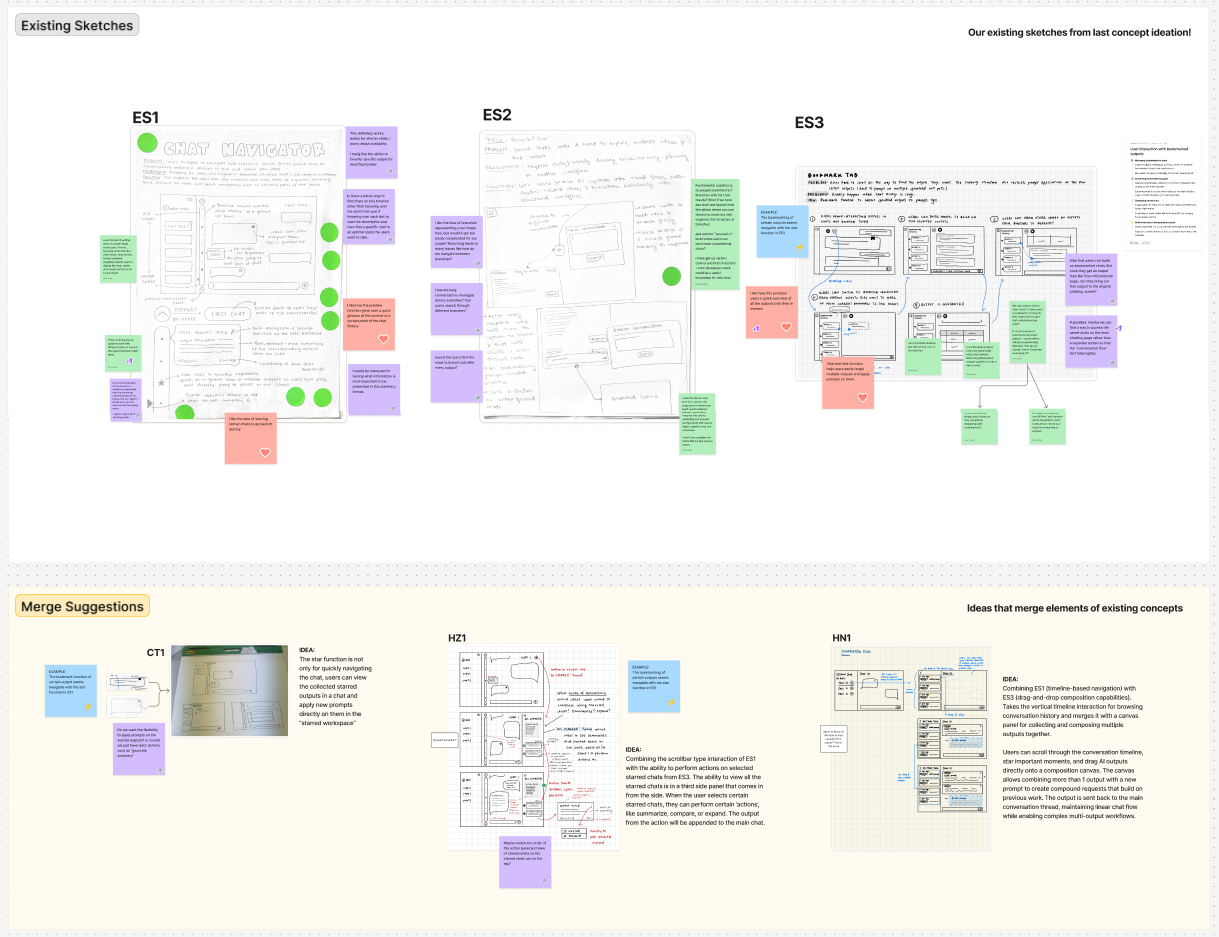
Based on these insights, we narrowed our focus toward bookmarking as the primary interaction, supported by lightweight navigation and AI-generated summaries. This direction preserved the linear chat structure while enabling non-linear behavior, letting users save, revisit, and act on meaningful outputs without cluttering the conversation. At the same time, we intentionally moved away from creative branching and tree-based exploration, which tested as visually heavy and misaligned with everyday workflows. The result was a more focused system centered on retrieval, re-entry, and iteration.
Solution: A Bookmarking System for a Non-Linear Workflow
Rather than replacing the familiar linear chat, Conversation Flow introduces lightweight layers of structure that help users re-enter, navigate, and build on past work without interrupting active thinking. The solution centers on preserving conversational continuity while enabling non-linear behavior when users need it.
Concept 1: The Bookmark Panel
A dedicated space for navigation and recall

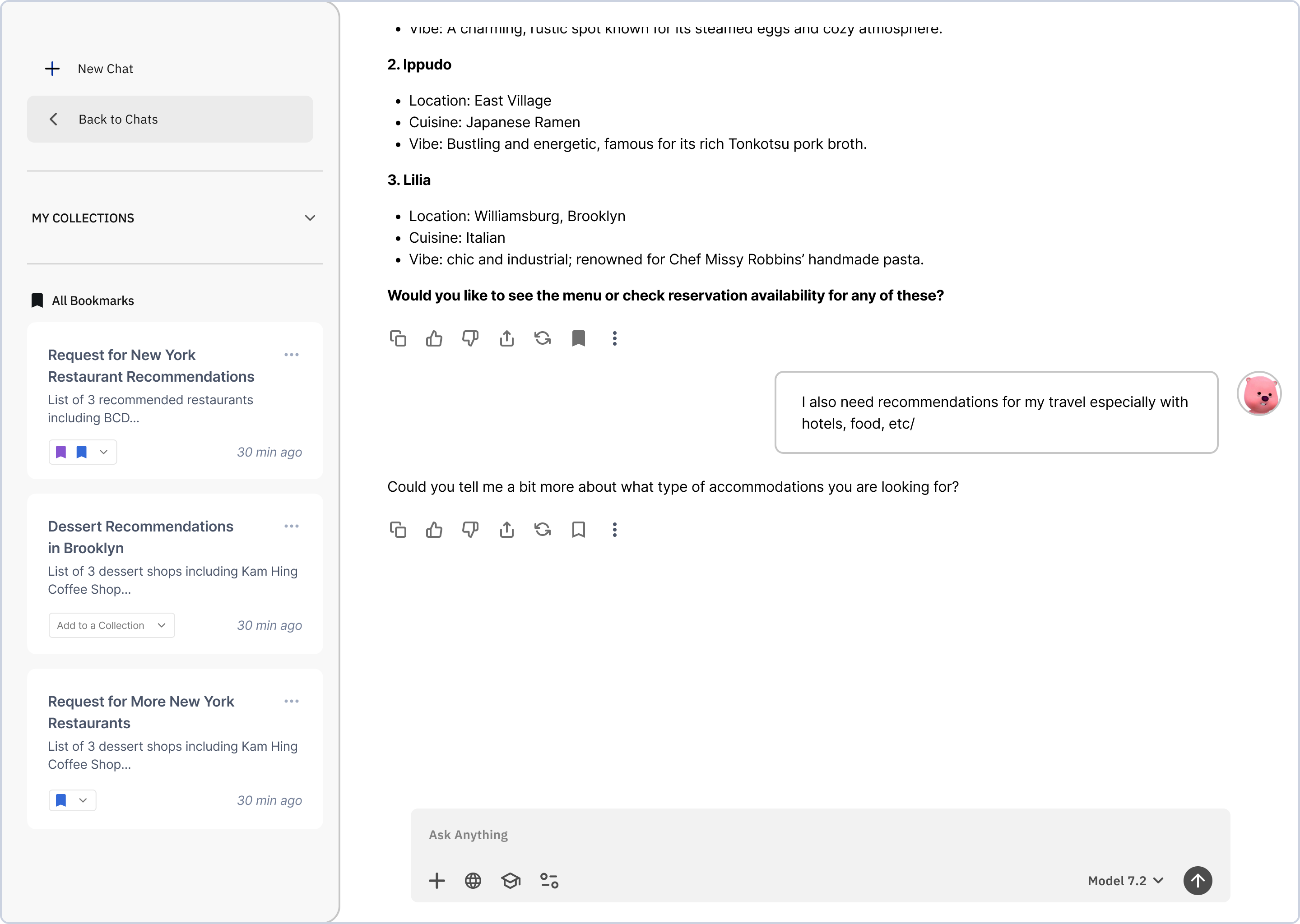
The Bookmark Panel provides a focused space for revisiting meaningful outputs from a conversation. Users can save individual AI responses directly within the chat and access them later through a collapsible panel. By separating retrieval from generation, the panel reduces the need to scroll or rely on memory, allowing users to quickly reorient themselves when returning to a conversation after time away. This turns long chats into navigable workspaces rather than static transcripts.
Concept 2: Bookmark Collections
Flexible organization across time and tasks
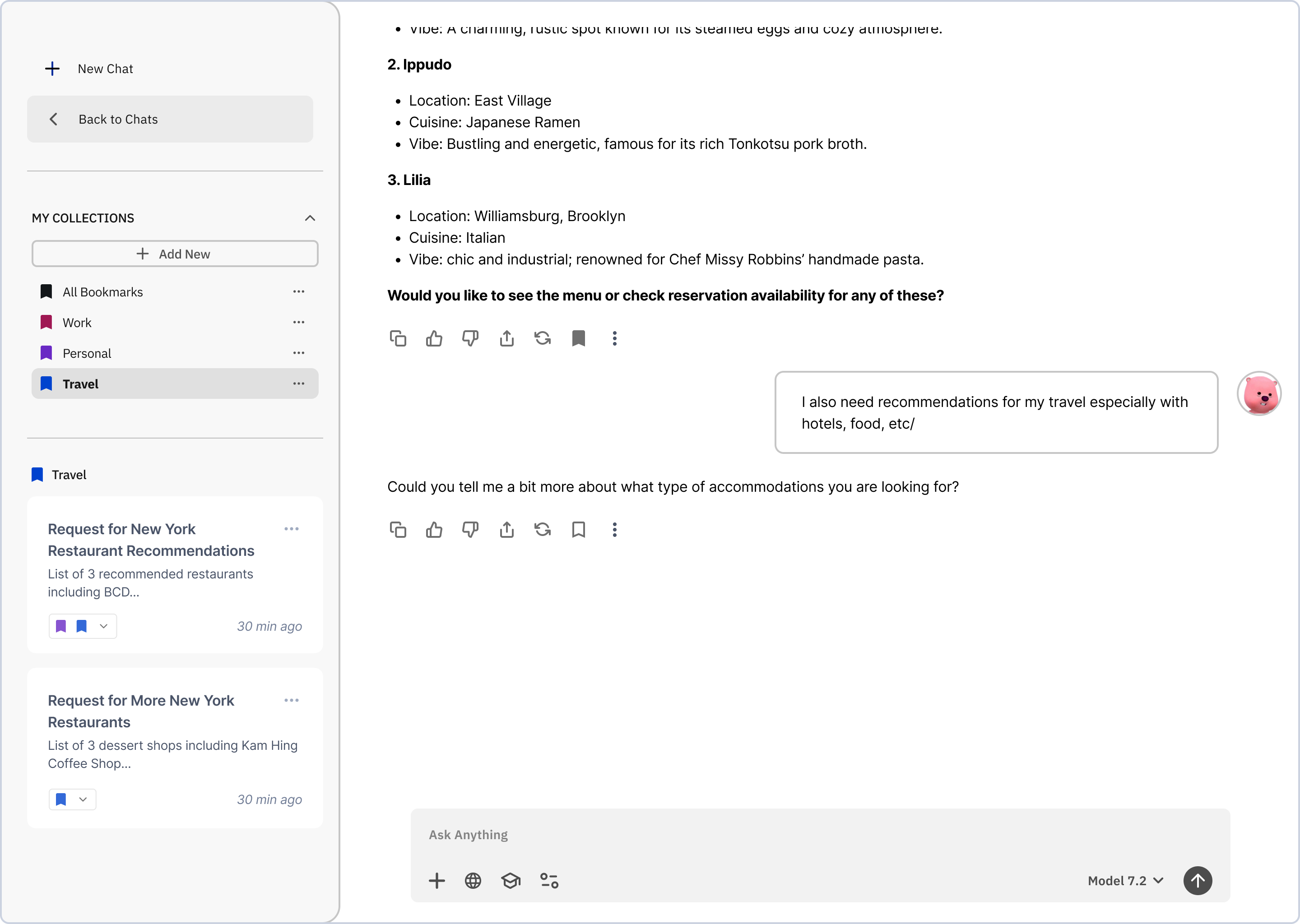
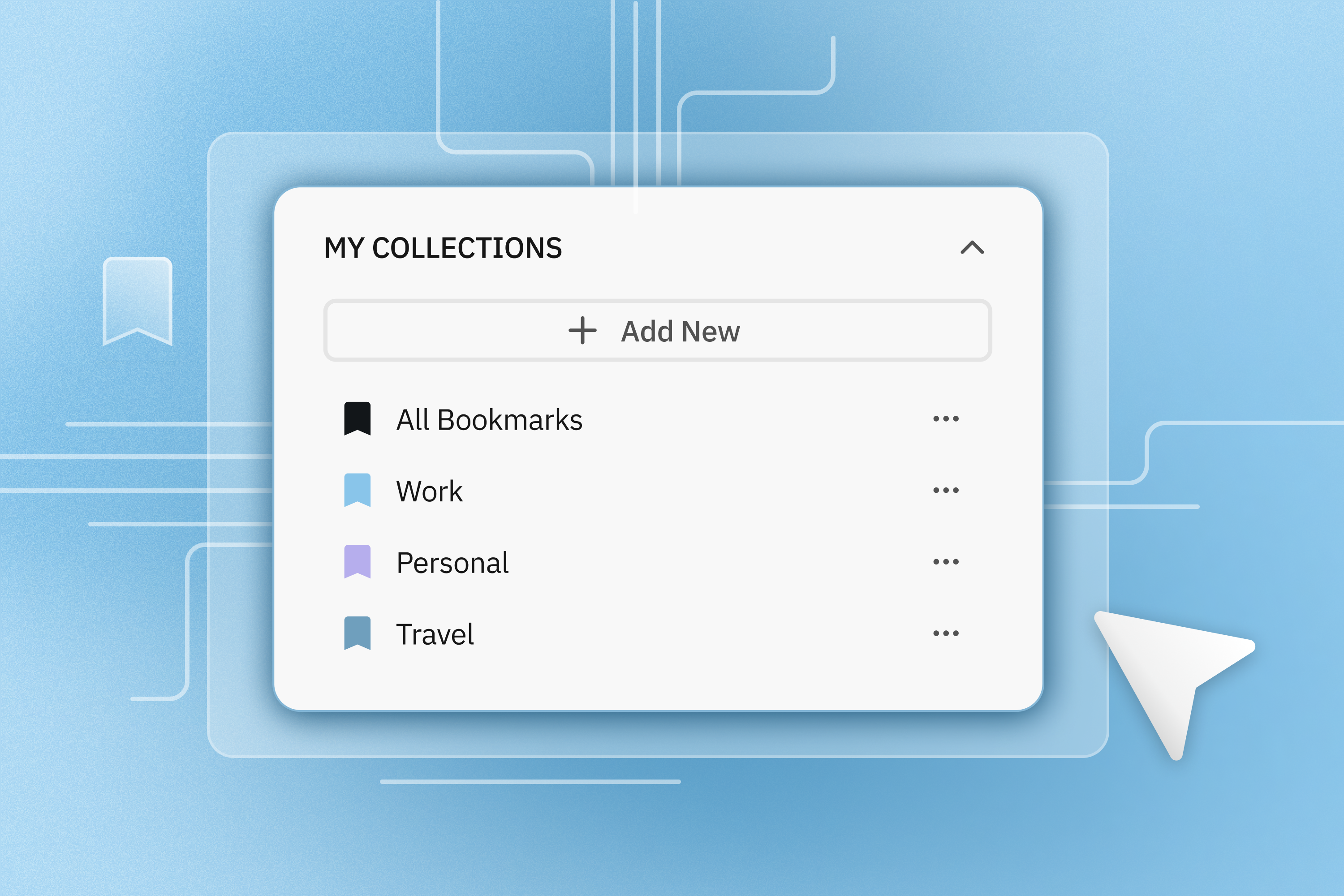
Bookmark Collections allow users to group saved outputs based on their evolving needs. Instead of enforcing rigid categories or a single organizational scheme, collections support flexible clustering (letting a single output live in multiple contexts). This reflects how users often reuse the same information across different tasks and stages of work, enabling non-linear reuse without requiring upfront planning or heavy management.
Concept 3: Directed Iteration
Focused refinement on the outputs that matter
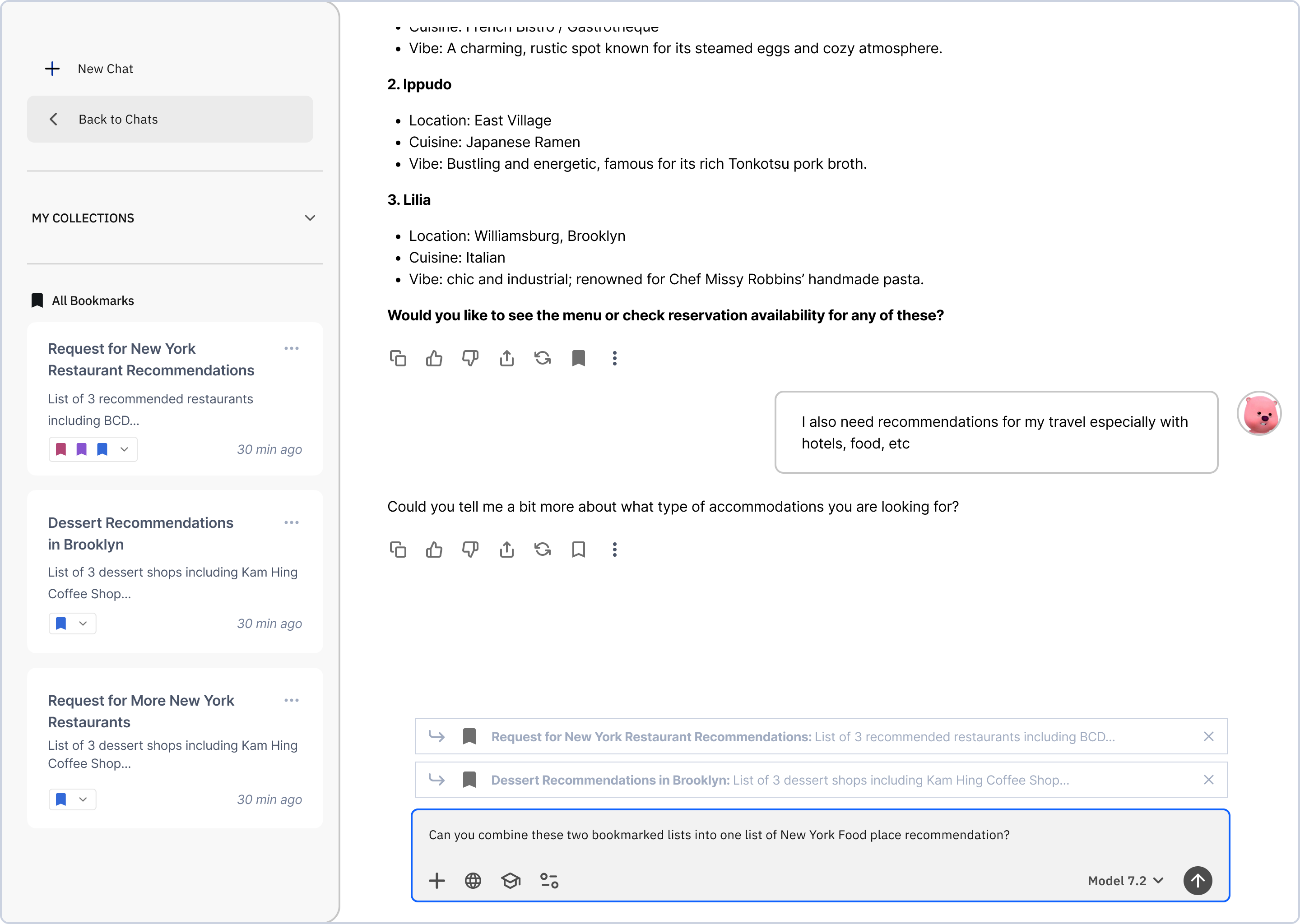
Directed Iteration supports a more intentional approach to refining ideas. Rather than appending follow-up prompts to the bottom of an ever-growing chat, users can select one or multiple bookmarked outputs, even across different conversations, and apply new prompts directly to them. This keeps revision anchored to the work that matters, preventing unrelated exchanges from fragmenting the process. The result is an experience that mirrors how people actually iterate: returning to a specific idea, refining it with purpose, and moving forward without losing context or momentum.
Why It Matters
As generative AI becomes embedded in everyday work, conversations are no longer disposable. They evolve into ongoing artifacts where people think, return, revise, and build over time. Yet most chat interfaces still treat conversations as linear, ephemeral streams, forcing users to rely on memory or start over when context is lost.
This project proposes a more human-centered alternative. By preserving the familiarity of linear chat while layering in structure only when needed, the system reduces cognitive load without over-structuring the experience. It supports re-entry, recall, and iteration in ways that respect users’ attention and agency, allowing them to stay oriented without being overwhelmed.
More broadly, this work suggests that effective AI interfaces should not aim to make conversations smarter by adding complexity, but calmer by reducing friction. As AI systems shift from one-off interactions to long-term collaborators, designing for continuity and cognitive support becomes essential to sustaining meaningful work with AI.
Future Directions
This work opens up opportunities to further explore how AI systems can support long-term thinking without taking control away from users. Future directions include deeper support for working across conversations and richer ways to reflect on how ideas evolve over time. These extensions would help users move fluidly between past and present work without relying on memory alone.
Beyond this project’s scope, there is also space to continue experimenting with conversational structure itself. While we intentionally moved away from branching and tree-based models due to their cognitive and feasibility tradeoffs, these forms remain compelling for supporting certain modes of thinking, such as divergent exploration or conceptual mapping. Future work could explore how alternative structures appear selectively, adapt to user intent, or coexist alongside linear chat to support different ways of thinking without becoming the dominant or default interaction.

Conversation Flow
Evolving the chat interface to move beyond the limitations of linear scrolling
Team Members
Dave Song
Cole Biehle
Hanara Nam
Holly Zhu
Celine Tseng
The Problem
Context Loss in Long-Running AI Work
With most generative AI platforms built around a strict, linear chat structure, users often find themselves quickly lost in conversations and chats. As prompts accumulate and conversations grow longer and more complex, chats become difficult to navigate, forcing users to scroll endlessly to locate a particular output from before.
This friction is especially pronounced for frequent users who return to chats days or weeks later to reuse crafts, refine ideas, or iterate on code. While the information still exists, it is buried within a continuous stream that relies heavily on users’ memory and patience to navigate.
Even when users do find the output they are looking for, iterating becomes another challenge. Follow-up prompts often inject new, unrelated outputs in between, pushing the original output further away. This makes it difficult to refine or build on a single result without noise, breaking focus and increasing cognitive load.
Together, these issues make it difficult for users to effectively navigate long conversations, revisit meaningful outputs, and iterate on ideas without losing focus. These frustrations led us to a key question:
How might we help frequent users easily navigate, revisit, and iterate on previous inputs and outputs within a long-running, linear chat?
Academic & Secondary Research
Findings from both an exploration of current solutions and user research suggest that while users benefit from non-linear ways of thinking and iterating with generative AI, they prefer solutions that build on familiar chat paradigms rather than replacing them.
Prior work such as Midjourney demonstrates how lightweight UI affordances can reduce friction in prompt iteration, while platforms like LAIERS highlight the potential of tree-like, non-linear conversation structures for exploration and comparison. Guided by these insights, we explored three design directions: enhanced timeline-based navigation within long chats, bookmarking meaningful outputs for later reuse, and a tree-based chat flow.
User research revealed that although tree-like visualizations were conceptually interesting, they introduced higher cognitive load and learning effort, and raised feasibility concerns beyond our problem scope. In contrast, navigation and bookmarking features are consistently tested as intuitive, quick to understand, and aligned with users’ existing mental models, supporting non-linear behavior without disrupting the overall chat structure.
From Framing to Exploration
Bringing together insights from research helped us land on a clear design question. From there, we moved straight into visual thinking. We used structured sketching to explore multiple directions before narrowing, rather than locking into one idea too early.
Insight 1
The Limits of Always-on Structure
Our first round of exploration pushed on how far AI conversations could be reshaped to support non-linear thinking. Concepts like Creative Branches, Prompt Editing, and Chat Trails experimented with making structure explicit. They explored branching conversations, externalizing prompt iteration, and visualizing chat history as something users could navigate and manipulate. While these ideas opened up new expressive possibilities, users were often unsure where to look, what to focus on, or how much they were expected to manage. Persistent visual structure risked pulling attention away from the conversation itself. This helped surface an early insight: adding structure alone does not guarantee clarity. Without careful restraint, even well-intentioned tools can make long conversations feel heavier rather than more navigable.
Insight 2
Letting the Conversation Lead
Building on those early learnings, our second iteration narrowed toward interventions that worked with the linear chat instead of abstracting away from it. Concepts like Chat Navigator, Bookmark Tab, and BranchFlow focused on helping users refine without asking them to manage an entirely new structure. Feedback showed that users valued having clear lightweight anchors such as saved outputs, summaries, and visible milestones. At the same time, this round surfaced another important constraint: users wanted control over when structure appeared and preferred tools that stayed out of the way until needed. This reinforced a second key insight: effective navigation in AI chats should feel optional and on-demand, supporting re-entry and iteration without competing for attention during active thinking.
User Testing Insights
Using feedback to simplify the experience and focus on what mattered most.
Takeaways from Testing
User testing clarified that the core problem was not a lack of expressive power, but friction in recall and reuse. Participants consistently gravitated toward simple, familiar interactions that helped them regain context quickly, especially after time away from a conversation. While advanced visualizations sparked curiosity, they often introduced cognitive overhead that distracted from the task at hand. Across interviews, users favored solutions that felt fast, optional, and embedded within their existing chat habits rather than systems that required learning a new mental model.
Converging the Direction
Based on these insights, we narrowed our focus toward bookmarking as the primary interaction, supported by lightweight navigation and AI-generated summaries. This direction preserved the linear chat structure while enabling non-linear behavior, letting users save, revisit, and act on meaningful outputs without cluttering the conversation. At the same time, we intentionally moved away from creative branching and tree-based exploration, which tested as visually heavy and misaligned with everyday workflows. The result was a more focused system centered on retrieval, re-entry, and iteration.
Solution: A Bookmarking System for a Non-Linear Workflow
Rather than replacing the familiar linear chat, Conversation Flow introduces lightweight layers of structure that help users re-enter, navigate, and build on past work without interrupting active thinking. The solution centers on preserving conversational continuity while enabling non-linear behavior when users need it.
Concept 1: The Bookmark Panel
A dedicated space for navigation and recall
The Bookmark Panel provides a focused space for revisiting meaningful outputs from a conversation. Users can save individual AI responses directly within the chat and access them later through a collapsible panel. By separating retrieval from generation, the panel reduces the need to scroll or rely on memory, allowing users to quickly reorient themselves when returning to a conversation after time away. This turns long chats into navigable workspaces rather than static transcripts.
Concept 2: Bookmark Collections
Flexible organization across time and tasks
Bookmark Collections allow users to group saved outputs based on their evolving needs. Instead of enforcing rigid categories or a single organizational scheme, collections support flexible clustering (letting a single output live in multiple contexts). This reflects how users often reuse the same information across different tasks and stages of work, enabling non-linear reuse without requiring upfront planning or heavy management.
Concept 3: Directed Iteration
Flexible organization across time and tasks
Bookmark Collections allow users to group saved outputs based on their evolving needs. Instead of enforcing rigid categories or a single organizational scheme, collections support flexible clustering (letting a single output live in multiple contexts). This reflects how users often reuse the same information across different tasks and stages of work, enabling non-linear reuse without requiring upfront planning or heavy management.
Why It Matters
As generative AI becomes embedded in everyday work, conversations are no longer disposable. They evolve into ongoing artifacts where people think, return, revise, and build over time. Yet most chat interfaces still treat conversations as linear, ephemeral streams, forcing users to rely on memory or start over when context is lost.
This project proposes a more human-centered alternative. By preserving the familiarity of linear chat while layering in structure only when needed, the system reduces cognitive load without over-structuring the experience. It supports re-entry, recall, and iteration in ways that respect users’ attention and agency, allowing them to stay oriented without being overwhelmed.
More broadly, this work suggests that effective AI interfaces should not aim to make conversations smarter by adding complexity, but calmer by reducing friction. As AI systems shift from one-off interactions to long-term collaborators, designing for continuity and cognitive support becomes essential to sustaining meaningful work with AI.
Future Directions
This work opens up opportunities to further explore how AI systems can support long-term thinking without taking control away from users. Future directions include deeper support for working across conversations and richer ways to reflect on how ideas evolve over time. These extensions would help users move fluidly between past and present work without relying on memory alone.
Beyond this project’s scope, there is also space to continue experimenting with conversational structure itself. While we intentionally moved away from branching and tree-based models due to their cognitive and feasibility tradeoffs, these forms remain compelling for supporting certain modes of thinking, such as divergent exploration or conceptual mapping. Future work could explore how alternative structures appear selectively, adapt to user intent, or coexist alongside linear chat to support different ways of thinking without becoming the dominant or default interaction.