Refinement Flow
Examining ways to shape AI outputs and preserve intent
Team Members



Holly Zhu
Erica Flora Yu


Zeana El-Hajomar
Celine Tseng
The Problem
AI is great at first drafts, terrible at refinement
Getting a first draft from AI is easy. Refining it is where things fall apart.
Generative AI tools excel at helping users get started. Still, during iteration, users are often stuck between broad “regenerate” actions that overwrite what works and manual edits that break flow and require switching tools.
This is especially frustrating in creative and analytical work, where progress often occurs through small incremental changes. Often, only a paragraph, sentence, or argument needs refinement, yet current AI workflows don’t support selective editing. Even follow-up prompts can feel risky, triggering unpredictable changes that overwrite intent or introduce new issues elsewhere.
As a result, refining AI-generated content becomes a disruptive process that forces users to choose between losing control and investing unnecessary effort.
These frustrations led us to ask:
How might we enable users to refine AI-generated content across multiple levels of depth while preserving their original structure and voice?
Academic & Secondary Research
During exploration, we examined how existing AI tools support refinement, focusing on Adobe Photoshop’s Generative Fill and SpecifyUI. Photoshop’s selection-based workflow inspired our targeted refinement and side-by-side comparisons, while SpecifyUI’s guided, structure-preserving edit commands informed our component-level refinement approach.
These explorations revealed key patterns: refinement at multiple levels, AI as a co-author rather than a replacement, and low-friction iteration that encourages experimentation. From these insights, we defined three core design principles:
- Support multi-level refinement from overview to fine details
- Enable precision while preserving structure
- Emphasize co-authorship over replacement
From Framing to Exploration
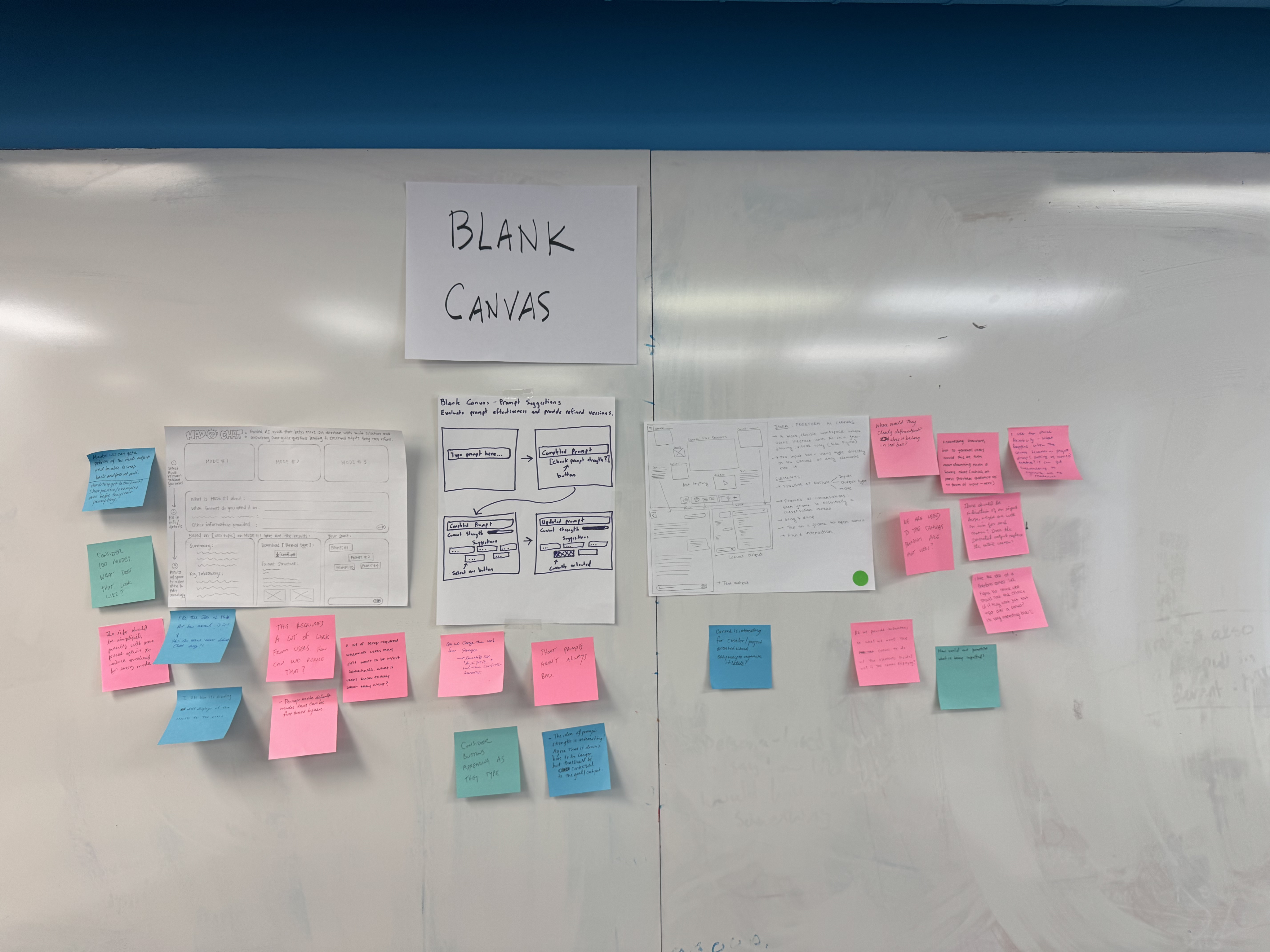
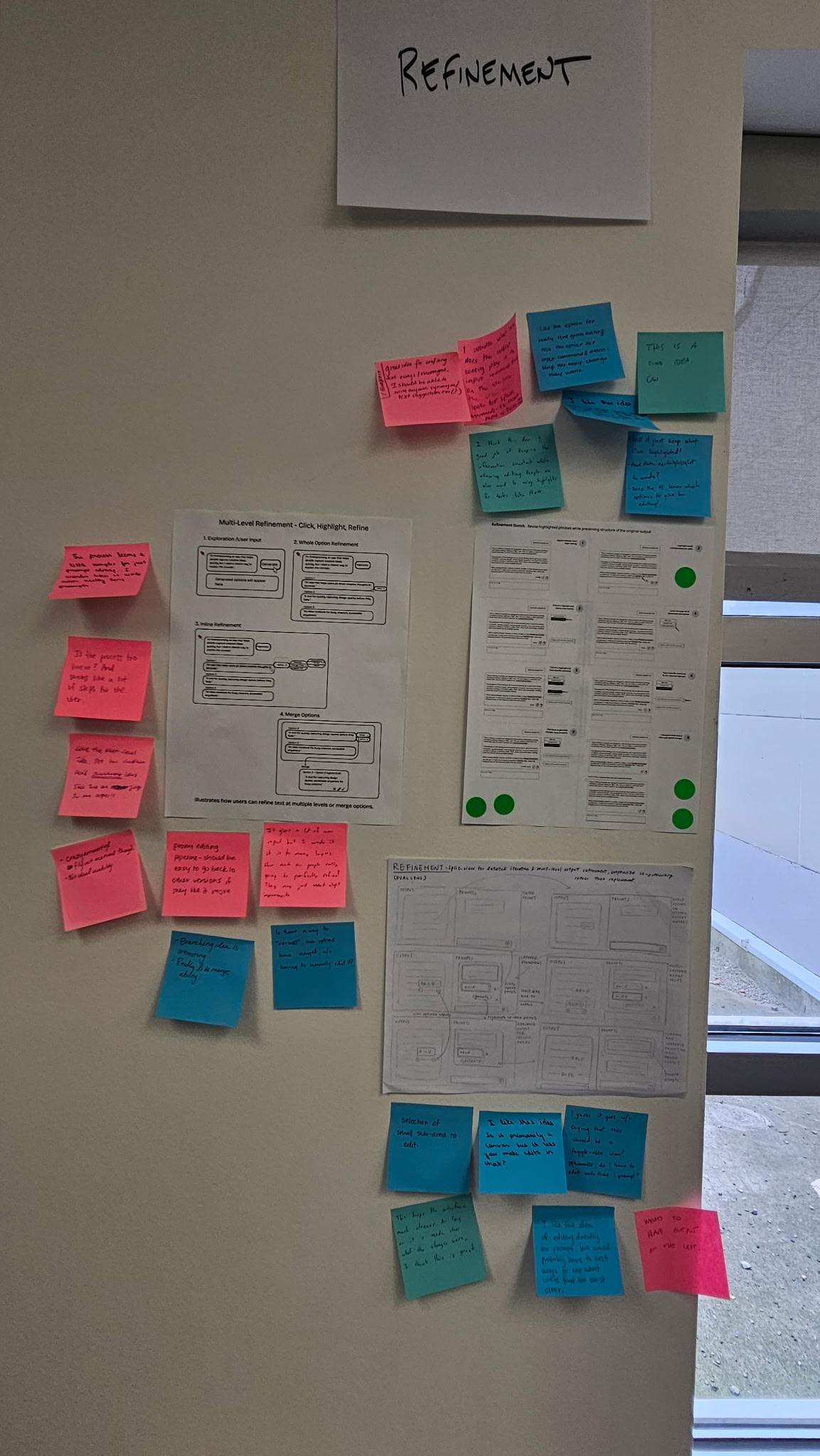
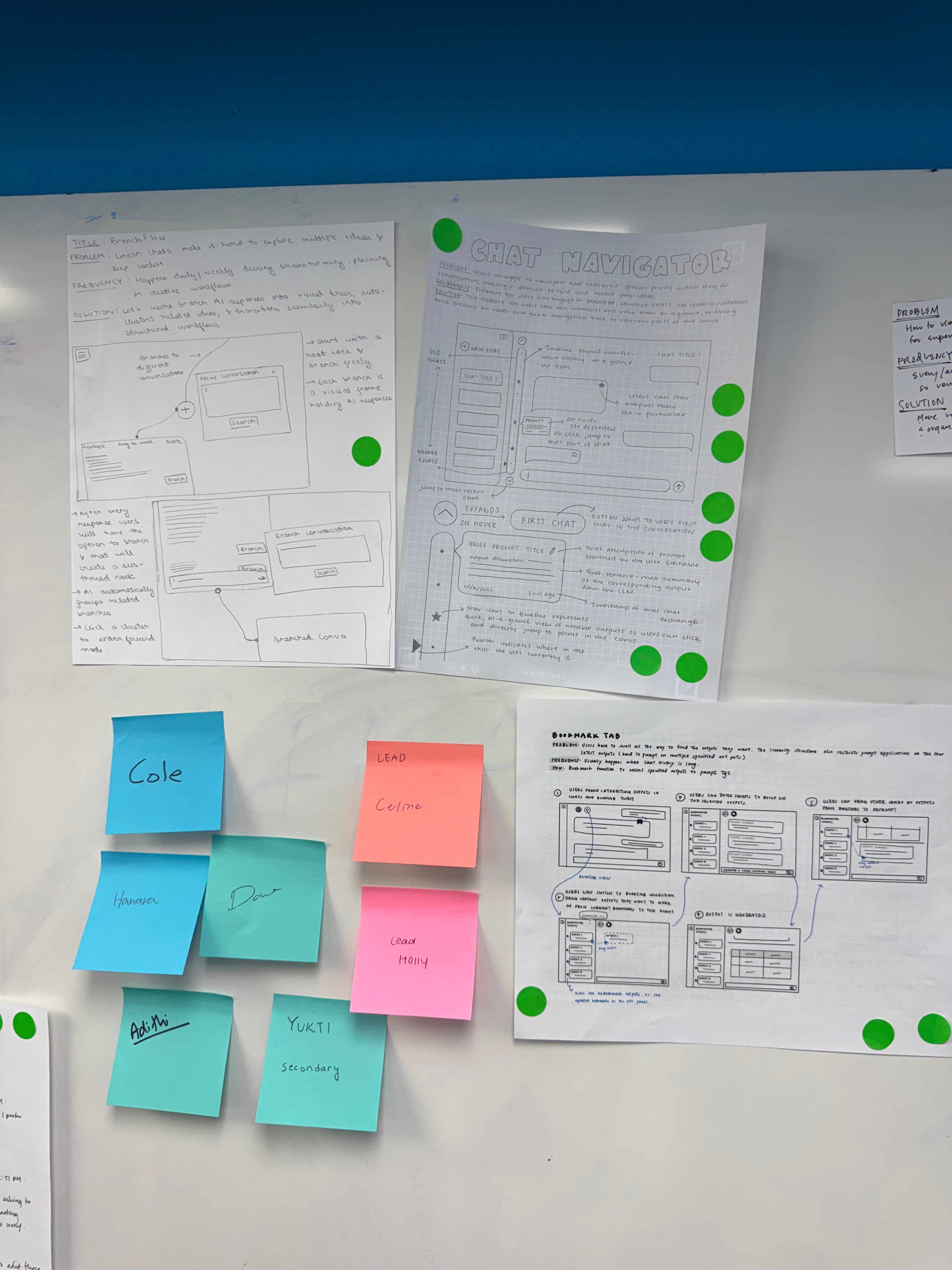
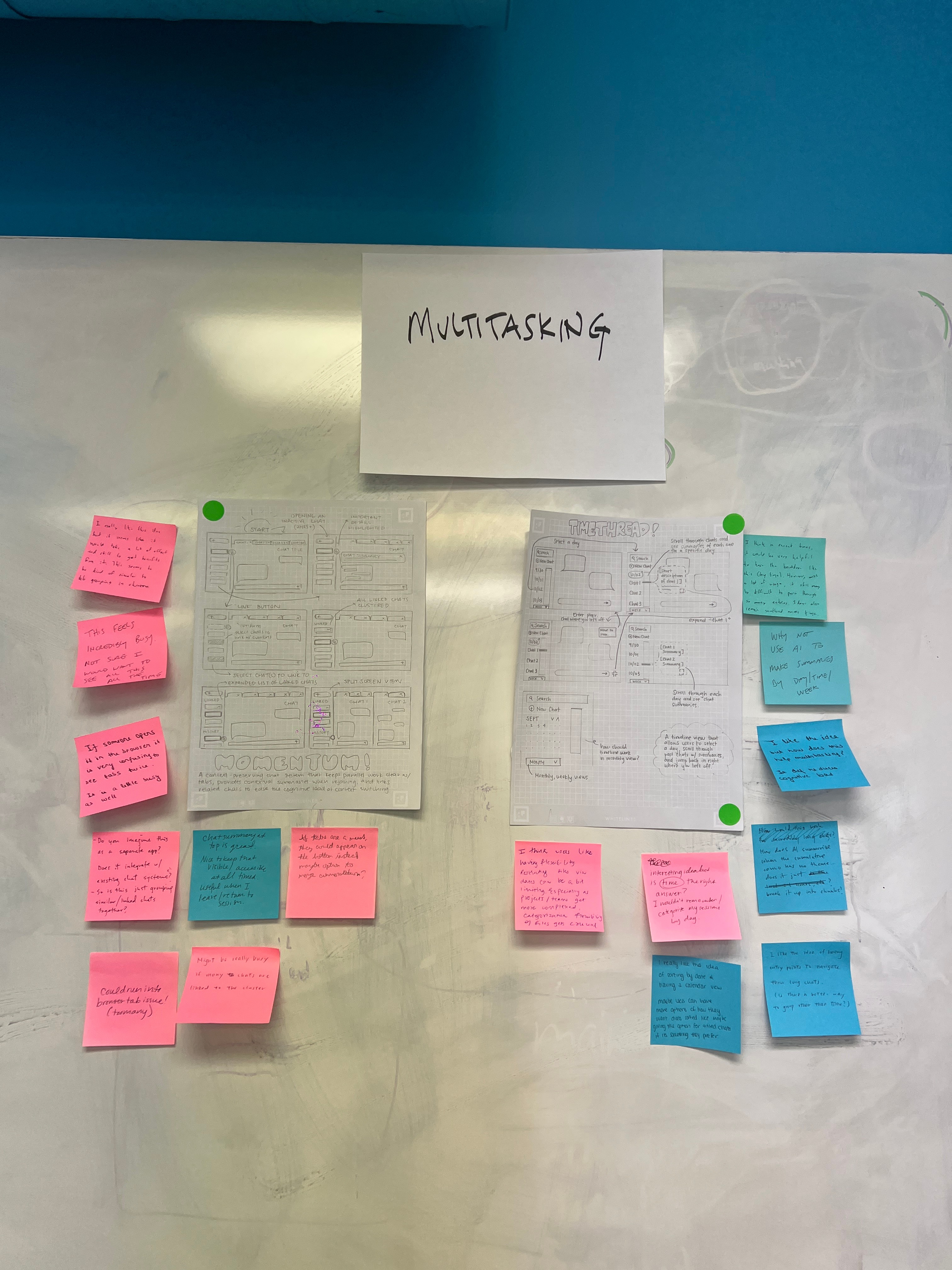
Bringing together insights from research helped us land on a clear design question. From there, we moved straight into visual thinking. We used structured sketching to explore multiple directions before narrowing, rather than locking into one idea too early.
Insight 1
Refinement Should Feel Effortless, Not Operated
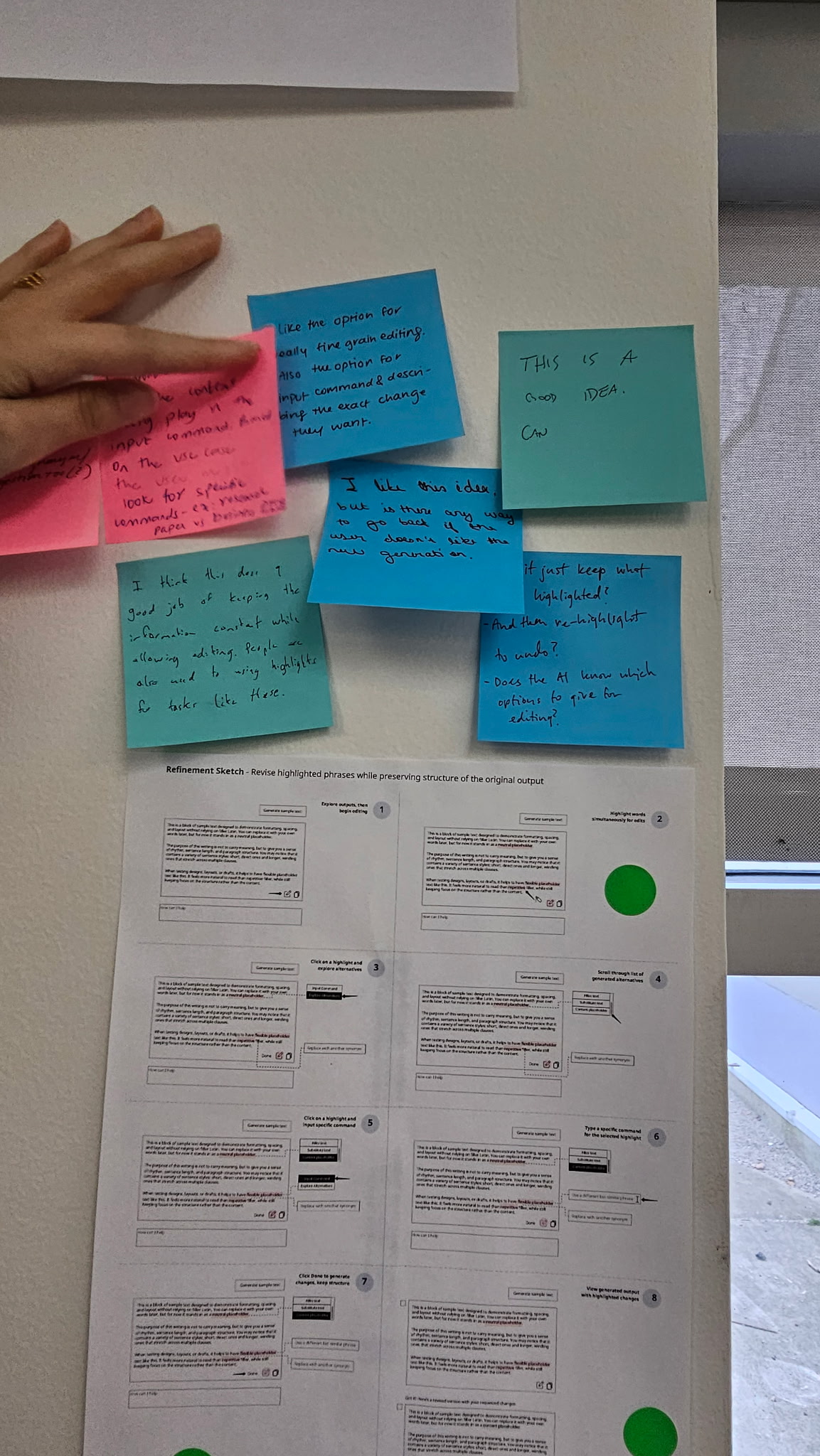
Across both critique sessions, users consistently gravitated toward interactions that minimized effort while maximizing control. Features like Quick Actions, phrase-level highlighting, and inline preview/accept flows were intuitive because they reduced the need to “manage the system.” Instead of navigating complex workflows, users preferred lightweight, direct manipulation—refining outputs in place with minimal steps.
At the same time, users valued being able to branch, merge, and edit outputs without losing stability. Maintaining a sense of continuity (e.g., keeping original content visible while iterating) increased confidence and reduced hesitation to explore changes.
This reveals a key insight: users don’t want to operate a system of tools—they want to fluidly shape outputs. Interactions that feel immediate, reversible, and low-effort build trust and encourage deeper engagement.
Insight 2
Control Comes from Lightweight Structure, Not Heavy Systems
While users appreciated advanced capabilities like version history, branching, and custom commands, they resisted anything that felt overly rigid or archival. Instead, they preferred structure that stayed out of the way—appearing only when needed and remaining easy to navigate.
Elements like inline highlighting, preview/accept controls, and simple version navigation (e.g., arrows) provided clarity without overwhelming the experience. Users also wanted flexibility in how they interacted—ranging from guided Quick Actions to writing their own commands—reinforcing the importance of layered control.
This surfaces a second key insight: effective systems balance power with restraint. Structure should support exploration and recovery (e.g., reverting, comparing, merging) without demanding constant attention or introducing cognitive overhead.
Solution: Reimagining how AI supports refinement
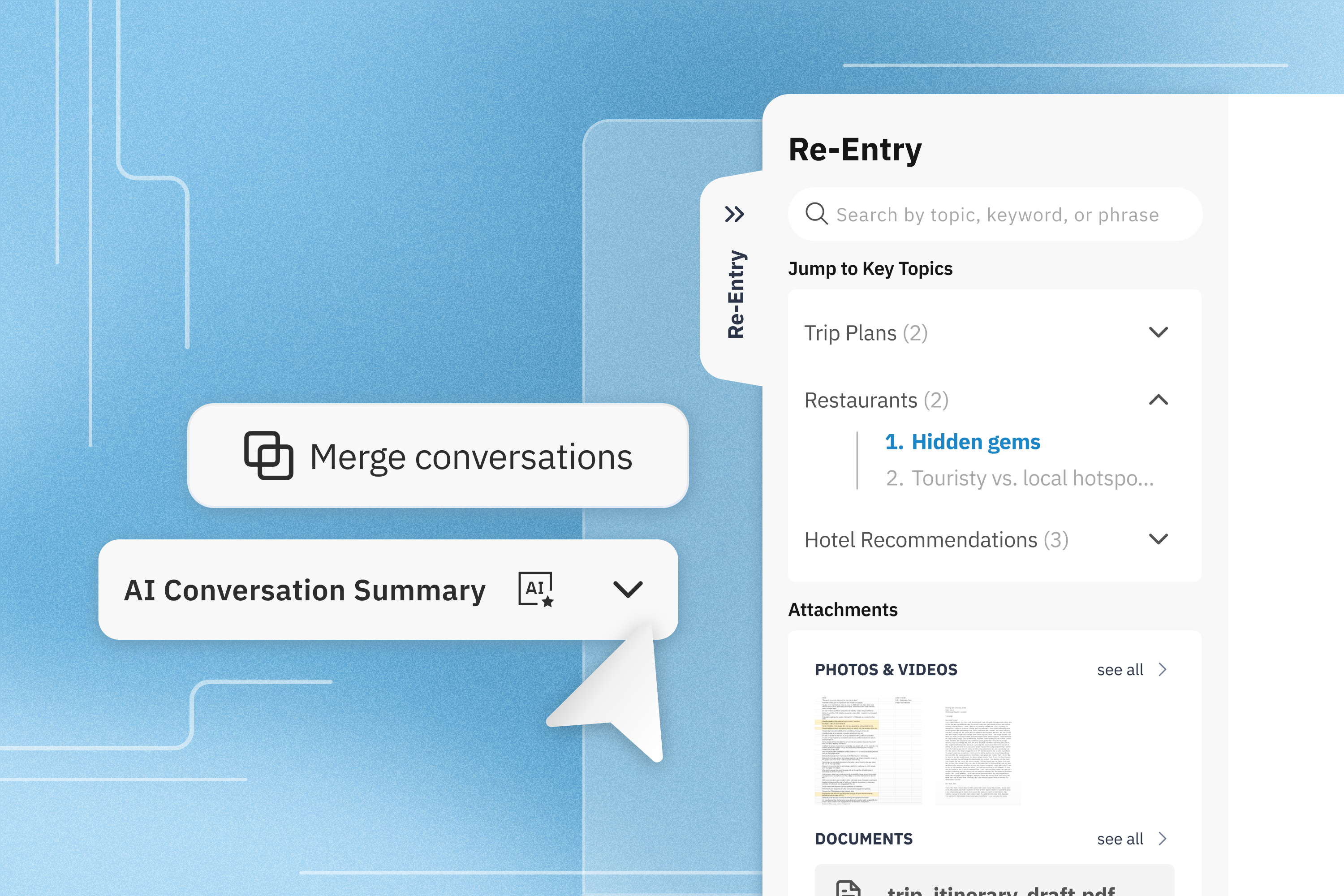
To address the limitations of all-or-nothing AI refinement, we designed a multi-level refinement workflow that allows users to iteratively improve AI-generated content without losing structure, intent, or control. Instead of treating refinement as a single regeneration step, our system supports refinement at different levels of depth, from broad adjustments to precise edits, allowing users to work the way real creative and analytical workflows unfold.
Concept 1: Big picture refinement without starting over
The system supports quick, high-level refinements- such as tone, length, or strength- allowing users to reshape entire outputs without rewriting prompts. By building on the original generation, users can explore variations while preserving core structure and ideas.
Concept 2: Refining what matters without breaking the rest
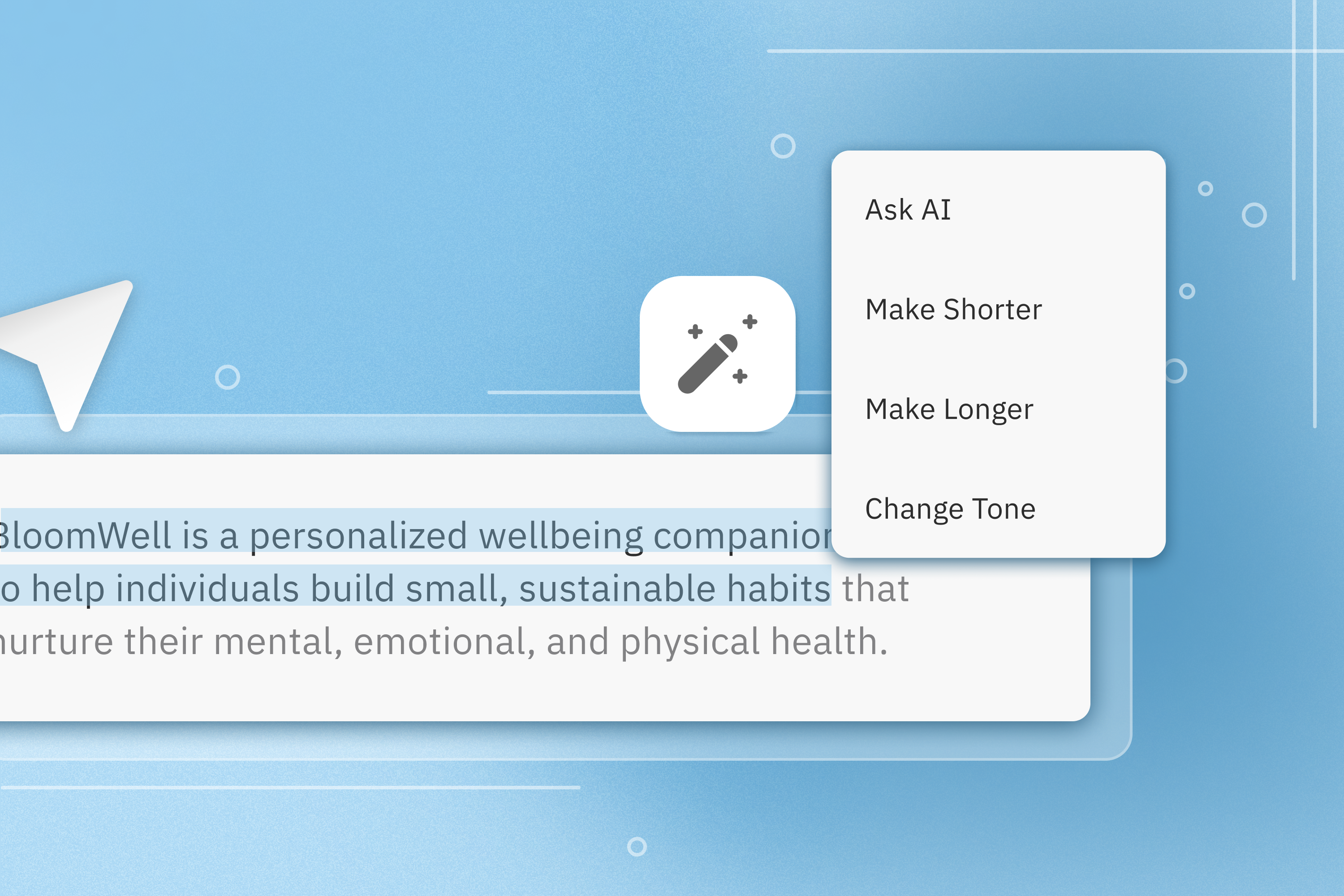
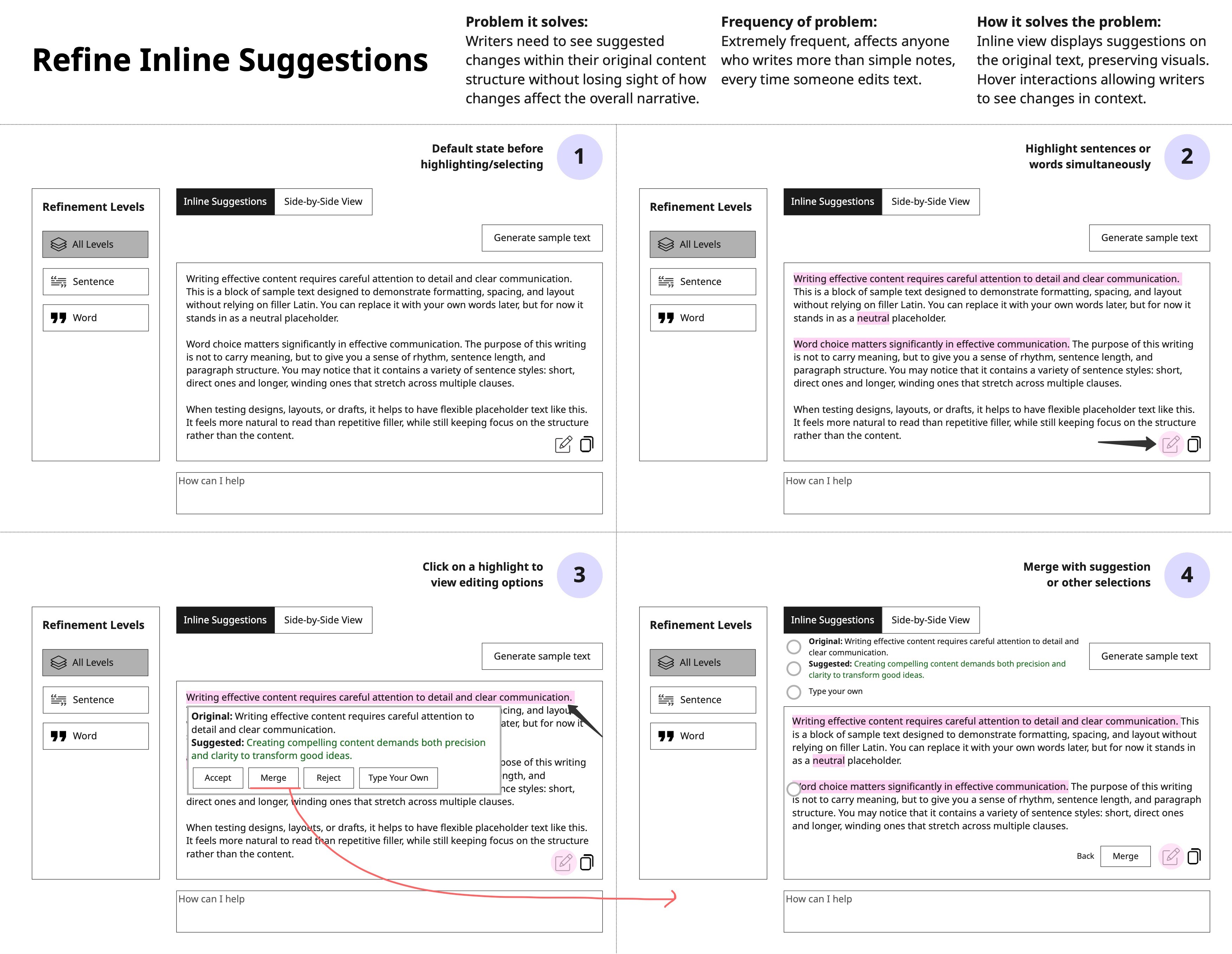
Users can refine specific regions such as paragraphs, sentences, or words without affecting the rest of the content. This targeted approach preserves structure and voice while enabling precise, iterative edits through quick actions (e.g., make shorter) or custom prompts via Ask AI.
Concept 3: Making iteration visible with side-by-side versions
To support transparency and decision-making, the system provides a side-by-side comparison using a toggle and navigation arrows, allowing users to evaluate original and refined versions, understand changes, and track idea evolution. This reinforces refinement as a collaborative process, where users choose what to keep, revise, or discard.
Why It Matters
As generative AI becomes embedded in everyday work, conversations are no longer disposable. They evolve into ongoing artifacts where people think, return, revise, and build over time. Yet most chat interfaces still treat conversations as linear, ephemeral streams, forcing users to rely on memory or start over when context is lost.
This project proposes a more human-centered alternative. By preserving the familiarity of linear chat while layering in structure only when needed, the system reduces cognitive load without over-structuring the experience. It supports re-entry, recall, and iteration in ways that respect users’ attention and agency, allowing them to stay oriented without being overwhelmed.
More broadly, this work suggests that effective AI interfaces should not aim to make conversations smarter by adding complexity, but calmer by reducing friction. As AI systems shift from one-off interactions to long-term collaborators, designing for continuity and cognitive support becomes essential to sustaining meaningful work with AI.
Future Directions
This project revealed that effective AI refinement is about giving users the right level of control at the right moment. By unifying “regenerate everything” and “edit manually,” we created a system that balances AI capability and the user’s creative judgment, an approach validated by testing.
Future opportunities include contextual AI reasoning to build trust by showing why changes were made, and refined memory to learn user preferences over time, surfacing relevant quick actions. Together, these ideas extend refinement beyond isolated interactions into a more adaptive, long-term relationship between user and AI.
Ultimately, the future of generative AI lies not in perfect first outputs, but in systems that make iteration feel natural, efficient, and empowering.




Refinement Flow
Examining ways to shape AI outputs and preserve intent
Team Members
Zeana El-Hajomar
Erica Flora Yu
Celine Tseng
The Problem
AI is great at first drafts, terrible at refinement
Getting a first draft from AI is easy. Refining it is where things fall apart.
Generative AI tools excel at helping users get started. Still, during iteration, users are often stuck between broad “regenerate” actions that overwrite what works and manual edits that break flow and require switching tools.
This is especially frustrating in creative and analytical work, where progress often occurs through small incremental changes. Often, only a paragraph, sentence, or argument needs refinement, yet current AI workflows don’t support selective editing. Even follow-up prompts can feel risky, triggering unpredictable changes that overwrite intent or introduce new issues elsewhere.
As a result, refining AI-generated content becomes a disruptive process that forces users to choose between losing control and investing unnecessary effort.
These frustrations led us to ask:
How might we enable users to refine AI-generated content across multiple levels of depth while preserving their original structure and voice?
Academic & Secondary Research
During exploration, we examined how existing AI tools support refinement, focusing on Adobe Photoshop’s Generative Fill and SpecifyUI. Photoshop’s selection-based workflow inspired our targeted refinement and side-by-side comparisons, while SpecifyUI’s guided, structure-preserving edit commands informed our component-level refinement approach.
These explorations revealed key patterns: refinement at multiple levels, AI as a co-author rather than a replacement, and low-friction iteration that encourages experimentation. From these insights, we defined three core design principles:
- Support multi-level refinement from overview to fine details
- Enable precision while preserving structure
- Emphasize co-authorship over replacement
From Framing to Exploration
Bringing together insights from research helped us land on a clear design question. From there, we moved straight into visual thinking. We used structured sketching to explore multiple directions before narrowing, rather than locking into one idea too early.
Insight 1
Refinement Should Feel Effortless, Not Operated
Across both critique sessions, users consistently gravitated toward interactions that minimized effort while maximizing control. Features like Quick Actions, phrase-level highlighting, and inline preview/accept flows were intuitive because they reduced the need to “manage the system.” Instead of navigating complex workflows, users preferred lightweight, direct manipulation—refining outputs in place with minimal steps.
At the same time, users valued being able to branch, merge, and edit outputs without losing stability. Maintaining a sense of continuity (e.g., keeping original content visible while iterating) increased confidence and reduced hesitation to explore changes.
This reveals a key insight: users don’t want to operate a system of tools—they want to fluidly shape outputs. Interactions that feel immediate, reversible, and low-effort build trust and encourage deeper engagement.
Insight 2
Control Comes from Lightweight Structure, Not Heavy Systems
While users appreciated advanced capabilities like version history, branching, and custom commands, they resisted anything that felt overly rigid or archival. Instead, they preferred structure that stayed out of the way—appearing only when needed and remaining easy to navigate.
Elements like inline highlighting, preview/accept controls, and simple version navigation (e.g., arrows) provided clarity without overwhelming the experience. Users also wanted flexibility in how they interacted—ranging from guided Quick Actions to writing their own commands—reinforcing the importance of layered control.
This surfaces a second key insight: effective systems balance power with restraint. Structure should support exploration and recovery (e.g., reverting, comparing, merging) without demanding constant attention or introducing cognitive overhead.
User Testing Insights
Using feedback to simplify the experience and focus on what mattered most.
We conducted two rounds of user testing to evaluate our core refinement concepts: Overall Refinement, Detailed Editing, and Merge.
Takeaways from Concept Validation
User testing showed that the main need was reducing friction in refining outputs, not generating new ones. Participants rarely accepted first responses, preferring to reprompt to avoid wasting LLM credits, reinforcing the value of inline refinement. Overall Refinement and Detailed Editing performed well, though users wanted clearer guidance, more visible prompts, and stronger AI affordances. The Merge concept created confusion and was deprioritized. Overall, users were most willing to adopt features that save time and reduce repetitive prompting.
Takeaways from Testing
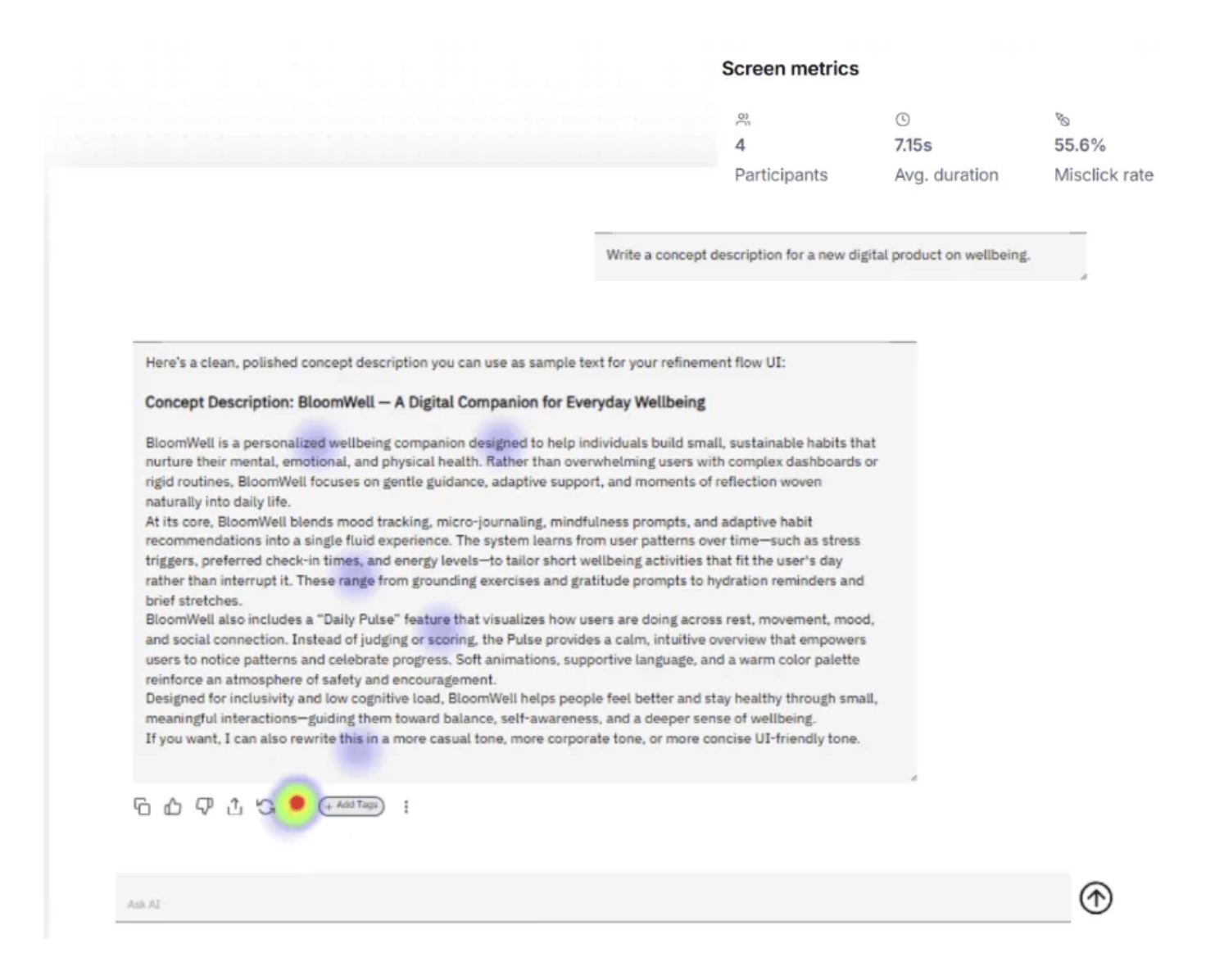
All flows achieved 100% task completion, but usability issues emerged around visibility and interaction clarity. Detailed Editing performed best with zero misclicks on AI shortcuts, while custom prompts and Overall Refinement showed confusion due to unclear affordances. Version History had the highest misclick rate, with controls placed outside expected locations. These results highlight the need to improve visibility, align controls with user expectations, and better distinguish between interaction levels.
Solution: Reimagining how AI supports refinement
To address the limitations of all-or-nothing AI refinement, we designed a multi-level refinement workflow that allows users to iteratively improve AI-generated content without losing structure, intent, or control. Instead of treating refinement as a single regeneration step, our system supports refinement at different levels of depth, from broad adjustments to precise edits, allowing users to work the way real creative and analytical workflows unfold.
Concept 1: Big picture refinement without starting over
The system supports quick, high-level refinements- such as tone, length, or strength- allowing users to reshape entire outputs without rewriting prompts. By building on the original generation, users can explore variations while preserving core structure and ideas.
Concept 2: Refining what matters without breaking the rest
Users can refine specific regions such as paragraphs, sentences, or words without affecting the rest of the content. This targeted approach preserves structure and voice while enabling precise, iterative edits through quick actions (e.g., make shorter) or custom prompts via Ask AI.
Concept 2: Refining what matters without breaking the rest
Users can refine specific regions such as paragraphs, sentences, or words without affecting the rest of the content. This targeted approach preserves structure and voice while enabling precise, iterative edits through quick actions (e.g., make shorter) or custom prompts via Ask AI.
Why It Matters
As generative AI becomes embedded in everyday workflows, conversations are no longer one-off interactions. They are evolving into ongoing artifacts that people revisit, refine, and build on over time. Yet most current AI interfaces still treat conversations as linear and disposable, forcing users to repeatedly prompt, remember prior context, or start over when progress is lost.
This project highlights a shift from generation to refinement. While AI excels at producing first drafts, real value emerges in the iterative process that follows. By enabling users to refine outputs at multiple levels—without losing structure or intent—the system reduces the friction between thinking and editing. It supports a more natural workflow where users can make incremental changes, stay in context, and maintain control over their ideas.
More broadly, this work suggests that the future of AI interfaces is not about making smarter outputs, but about designing better collaboration. As users move from isolated prompts to sustained interaction with AI, systems must prioritize continuity, clarity, and user agency. Designing for refinement, rather than replacement, allows AI to function as a true creative partner—supporting deeper, more meaningful work over time.
Future Directions
This project revealed that effective AI refinement is about giving users the right level of control at the right moment. By unifying “regenerate everything” and “edit manually,” we created a system that balances AI capability and the user’s creative judgment, an approach validated by testing.
Future opportunities include contextual AI reasoning to build trust by showing why changes were made, and refined memory to learn user preferences over time, surfacing relevant quick actions. Together, these ideas extend refinement beyond isolated interactions into a more adaptive, long-term relationship between user and AI.
Ultimately, the future of generative AI lies not in perfect first outputs, but in systems that make iteration feel natural, efficient, and empowering.